
Modern Technologies
Next.js, React and TypeScript by default.
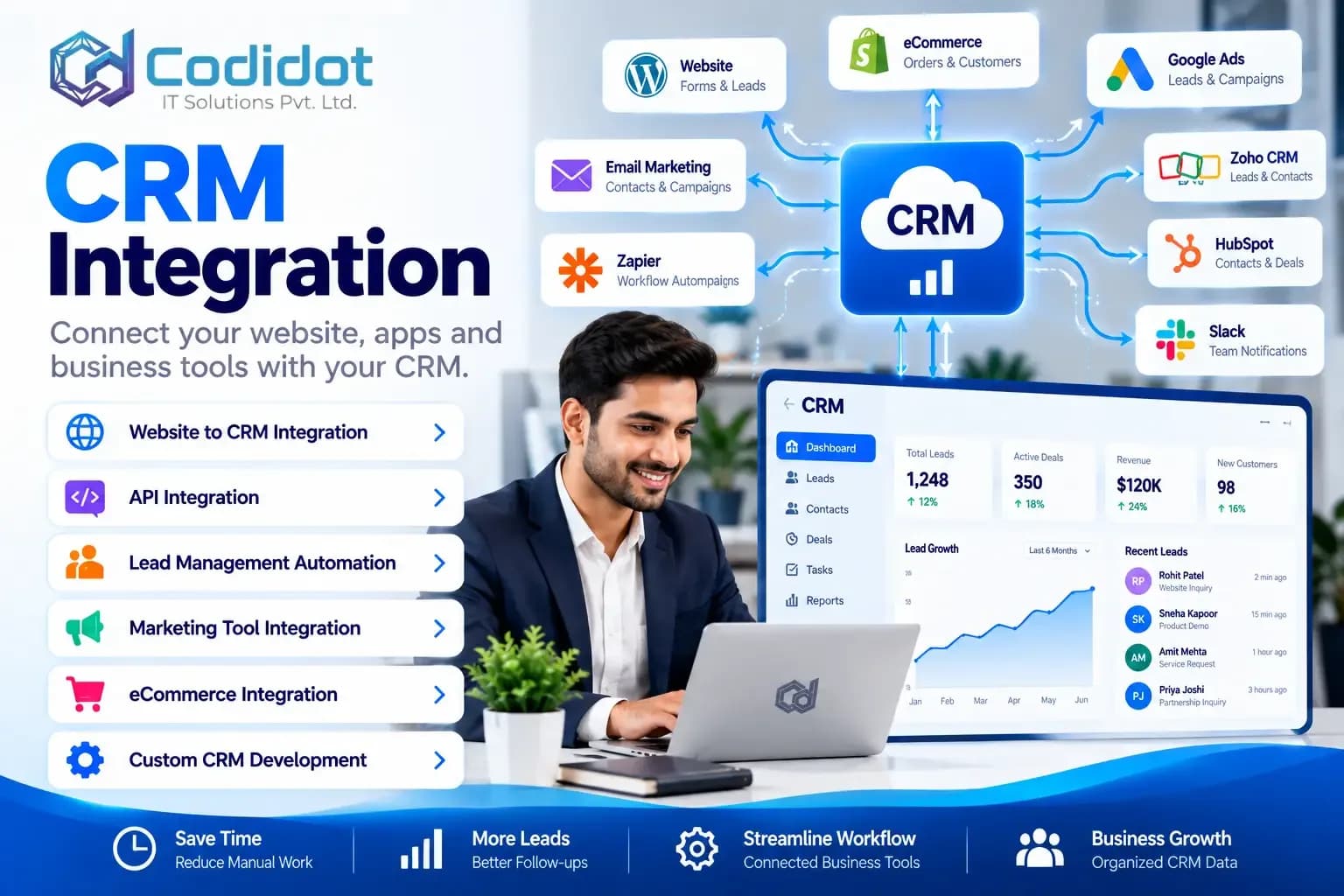
Connect your website, CRM, forms and business applications with custom CRM integration services from CODIDOT. Automate lead management and workflows.
Next.js, React and TypeScript by default.
Technical SEO baked in from the first commit.
Built to grow with your traffic and team.
Hardened, monitored and regularly updated.
A CRM system becomes more useful when it works seamlessly with the other tools your business depends on. Your website, landing pages, email platforms, sales applications, customer support tools, and internal systems may all contain information that your team needs to manage customer relationships effectively.
CODIDOT provides CRM integration services designed to improve how these systems communicate and exchange information.
We begin by understanding your current business processes, CRM platform, data structure, and integration requirements. Based on these details, we plan a suitable integration approach using available APIs, webhooks, supported connectors, plugins, or custom development.
Our objective is to reduce unnecessary manual work, improve data consistency, and create more connected workflows across your organization.
Explore our web development services to learn more about our website and application development capabilities.
Connect your business website directly with your CRM system so that customer inquiries and lead information can enter your sales workflow efficiently.
Many businesses receive inquiries through contact forms, quote requests, service pages, landing pages, and appointment forms. Without a proper integration, employees may need to copy this information manually into their CRM.
With website-to-CRM integration, form submissions can be transferred to the appropriate CRM module using a supported integration method. Depending on the requirements, the workflow can also assign leads, store source information, create tasks, and notify the relevant team.
Our website-to-CRM integration services include:
Contact form and inquiry form integration
Landing page lead capture
Service request and quotation form integration
Lead source and campaign data mapping
Automatic contact and lead record creation
Field mapping and data validation
Duplicate record handling based on defined rules
Notifications for new inquiries
Integration testing and error handling
For example, when a visitor submits a website inquiry, the system can transfer the submitted details to your CRM, identify the appropriate lead source, and notify the responsible sales representative.
This helps reduce manual data entry and provides a more consistent process for managing incoming inquiries.
Connect your CRM with websites, custom applications, databases, and third-party business software through suitable APIs.
CRM API integration is useful when standard plugins or native connectors cannot support your complete business requirements. A custom integration can exchange data between compatible systems and implement specific business rules.
CODIDOT can assess your API requirements and develop integrations based on the available documentation, authentication methods, permissions, rate limits, and data structures.
Our CRM API integration capabilities include:
Custom REST API integration
Lead and contact synchronization
Customer and company record integration
Sales opportunity and deal synchronization
Custom field mapping
Record creation and updates
API authentication and access management
Webhook-based event processing where supported
Error logging and retry handling
Integration testing and maintenance planning
For example, a custom web application may need to create CRM leads when a user completes a registration process. An internal dashboard may need to retrieve selected customer records from the CRM. A business platform may need to synchronize updates between systems.
We design these integrations around the specific data that needs to be exchanged and the rules that govern how records should be created, updated, or matched.
Learn more about our web development services for custom application development and integration projects.
Connect your website and business applications with Zoho CRM to organize leads, contacts, deals, and related business workflows.
Zoho CRM provides developer APIs and SDKs for integrating CRM records and extending its functionality. The precise integration depends on your Zoho configuration, account permissions, available modules, and business requirements.
CODIDOT can help plan and implement Zoho CRM integrations for suitable website and application workflows.
Our Zoho CRM integration services may include:
Website form to Zoho CRM integration
Lead and contact creation
CRM field mapping and data validation
Custom web application integration
Lead source tracking
Record synchronization between compatible systems
Deal and sales workflow integrations
Custom API-based functionality
Error handling and integration monitoring
For example, when a prospective customer submits a service inquiry on your website, the integration can create a lead in Zoho CRM and store the available inquiry details. Depending on your workflow, it may also create a follow-up task or notify the assigned team member.
For more advanced requirements, custom API integration can help connect Zoho CRM with your internal software or other compatible applications.
Explore the official Zoho CRM developer documentation for details about supported APIs and integration capabilities.
Improve your sales and customer management processes with CRM workflow automation.
CRM integration can do more than transfer information between systems. It can also trigger actions when specific events occur, helping your team follow a consistent process.
For example, a new lead may need to be assigned to a sales representative, a follow-up task may need to be created, or a notification may need to be sent when an opportunity reaches a particular stage.
Our CRM workflow automation services include:
Automatic lead assignment
Follow-up task creation
Lead status and stage updates
Notifications for new customer inquiries
Reminders for pending sales activities
Workflow triggers based on defined conditions
Customer record update workflows
Integration with compatible email and communication tools
Sales process and approval workflows
We first review your existing sales process and identify which actions can be automated safely and reliably. We then configure or develop the required workflows based on the capabilities of your CRM platform and connected applications.
Appropriate validation, duplicate handling, permissions, and exception management help keep these workflows consistent and maintainable.
Bring customer and campaign information together by connecting your CRM with compatible marketing platforms and lead generation tools.
Marketing teams often collect leads from landing pages, advertising campaigns, newsletter subscriptions, event registrations, and other sources. Integrating these channels with a CRM can help organize the information and make lead sources easier to track.
Our marketing-related CRM integrations may include:
Landing page and campaign form integration
Lead source and campaign data mapping
Marketing contact synchronization
Newsletter subscription workflows
Contact segmentation based on available fields
Lead routing and notification workflows
Marketing platform integrations through supported APIs
Data synchronization and validation
For example, a business running multiple marketing campaigns can send website inquiries into its CRM with the available source and campaign details. This can help sales teams understand where an inquiry originated and support campaign reporting.
Any marketing communication must follow applicable consent requirements, privacy obligations, and the capabilities of the connected platforms.
Connect your online store with your CRM to create a more organized view of customer interactions and selected business data.
eCommerce businesses may manage customer information, product inquiries, order records, and support requests across separate systems. An appropriate integration can reduce manual transfers and help teams access relevant customer information.
Our eCommerce CRM integration services may include:
Customer record synchronization
Online store inquiry integration
Customer support workflow integration
Selected order data synchronization
Customer segmentation based on permitted data
Notifications for defined customer events
CRM integration with compatible store platforms
Custom data mapping and validation
For example, an online store may send customer details to a CRM when a defined event occurs. A support team may then use the available customer record to organize follow-ups and manage service inquiries.
The scope of an eCommerce integration depends on the platform, available APIs, data permissions, and business requirements. Sensitive customer information should only be transferred when necessary and with appropriate safeguards.
If your business relies on custom software, internal dashboards, or specialized applications, a standard connector may not cover every requirement.
CODIDOT can help assess custom CRM integration opportunities and develop connections between your CRM and compatible business applications.
Custom integration services can include:
Internal dashboard and CRM integration
Custom PHP application integration
Database-to-CRM data exchange where supported and appropriate
Customer portal integration
Business reporting integrations
Custom API endpoints and middleware
Record synchronization between selected systems
Field transformation and validation
Integration logging and exception handling
We assess the best integration architecture based on your existing software, security requirements, data volume, and expected workflow.
For systems containing important business data, we also consider backup strategies, access restrictions, synchronization rules, and procedures for handling failed requests.
The right integration approach depends on your existing CRM platform and the software you use every day.
Integrate websites, custom applications, and compatible business tools with Zoho CRM using supported APIs and integration options.
We can evaluate integration requirements for other CRM systems based on their available APIs, permissions, documentation, and supported connection methods.
Connect suitable WordPress forms, websites, and custom functionality with your CRM to streamline inquiry management and lead capture.
Evaluate integrations between compatible eCommerce systems and your CRM for customer information, inquiry workflows, and selected business events.
Integrate CRM functionality into custom web applications using supported APIs, server-side logic, and appropriate authentication.
Platform compatibility and the final scope should be confirmed before development begins.
Transfer information between compatible systems automatically instead of repeatedly entering the same information in multiple places.
Capture inquiries from connected sources and route them into a structured sales process.
Use defined field mapping, validation, and duplicate-handling rules to help reduce inconsistencies across connected systems.
Create tasks, notifications, and reminders when relevant events occur, helping your team respond according to its sales process.
Bring relevant customer and inquiry information into your CRM so authorized team members can access the information they need.
Link lead sources and campaign data with CRM records to support more organized lead management and reporting.
Reduce unnecessary switching between applications and simplify workflows that depend on information from multiple systems.
Plan integrations that can be maintained and extended as your business processes and software requirements evolve.
Actual benefits depend on your existing processes, integration scope, data quality, and implementation.
We review your current CRM, connected applications, business workflows, data fields, and integration objectives.
We define the required data flow, supported connection methods, field mapping, synchronization direction, permissions, and expected results.
We select a suitable integration approach using available APIs, webhooks, supported connectors, plugins, or custom application development.
We implement the agreed integration, including data transformation, workflow rules, authentication, and error-handling mechanisms.
We test record creation, updates, field mapping, duplicate handling, permissions, API failures, and other relevant scenarios.
After successful validation, the integration can be deployed to the agreed environment, with implementation details and operational guidance according to the project scope.
We can help review integration performance, investigate errors, and plan improvements as your business requirements change.
CODIDOT IT Solutions combines web development, API integration, custom application development, and business workflow implementation to help companies connect their software systems.
We start by understanding your workflow and desired outcomes instead of recommending unnecessary integrations.
Where standard connectors are insufficient, we can assess custom development options based on your software and API requirements.
We can evaluate integrations with compatible WordPress websites, custom applications, eCommerce platforms, and other business systems.
We plan how fields and records should move between systems, including appropriate validation and duplicate-handling rules.
We consider authentication, access permissions, sensitive information, error logging, and data handling throughout the integration process.
We aim to develop integrations that can be tested, monitored, and maintained as connected systems evolve.
Explore our web development services or contact our team to discuss your CRM integration requirements.
We understand your business, audience, goals and project requirements.
We define the technology, architecture, features and development roadmap.
We create intuitive interfaces focused on usability, branding and conversion.
Our developers turn the approved design into a fast, responsive and scalable website.
We test, optimize and launch your website with the support you need after deployment.
 Next.jsReactTypeScriptNode.jsPostgreSQLTailwind CSS
Our client’s success is our biggest achievement. See what they have to say about working with Codidot.
“Codidot delivered an exceptional website for our business. Their team understood our requirements perfectly and the results exceeded our expectations.”
 Rahul MehtaFounder & CEO, TechNova
500+
Happy Clients


We build fast, scalable and conversion-focused websites that help businesses attract customers, strengthen their brand and grow online.
Explore MoreAutomate your business processes with smart AI solutions and save time & resources.
Explore MorePowerful e-commerce solutions that drive sales and growth.
Explore MoreLet’s discuss your project and turn your ideas into reality.
Join 500+ businesses that trust Codidot.


